

3 Reasons Why You Need the Scarf Method When You Air Dry Your Hair! | Relaxed Hair
Hair Health Wednesday, July 15, 2020
So it's wash day, right?! You've already shampooed, deep conditioned, and applied your leave-ins. Now it's time to dry your hair BUT you immediately go into a state of panic! Why? Because the next and healthiest step, is air drying your hair but fear of the unknown kicks in = untamed, puffy hair! *Sigh* Lesson learned, hair should always be guided and controlled as it dries. Rest assured, air drying can be made easy with the help of implementing the Scarf Method!
What exactly is the Scarf Method?
The Scarf Method is a process that involves gently combing your damp hair (setting it the way you want it to dry - with or without a part) and then applying a satin/silk scarf around your hairline after wash day is complete. Once your hair is completely dry, remove the satin/silk scarf and the end result leaves you with smooth edges and hair! What more could you ask for?!
If you haven't incorporated this method into your wash day regimen, you're truly missing out!
 |
| Scarf Method on Air Dried Hair |
Here are 3 Reasons Why You Need the Scarf Method When You Air Dry!
1. Gives your hair structure while drying!
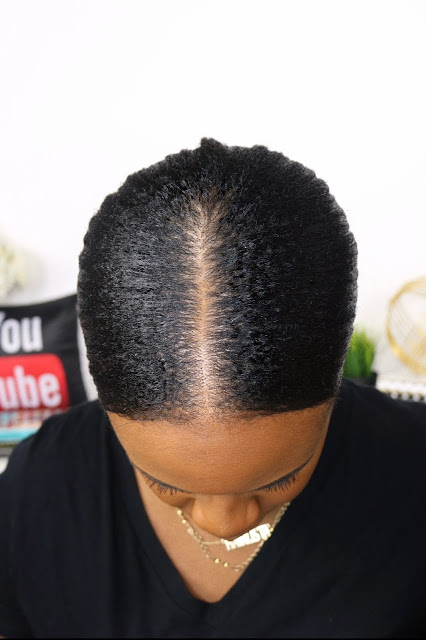
We all know that air drying is the safest and easiest way to dry your hair. However, air drying can cause the hair to dry with an undesirable 'puffy' look if not properly and carefully prepped beforehand. The purpose of applying a scarf on the hairline, while the hair is damp, is that it forces the hair to dry straight. The hair is smoothed into place, with the help of the scarf, aiming to help flatten your edges and roots. The hair maintains this straight shape until it's time to wash again. Without structure, textured hair can dry with bends and curves in the hair shaft causing tangles and breakage.
2. Lays your hairline and new growth flat!
Less manipulation the next day is what I'm all about! This is so essential especially when stretching your relaxers. It really slows the urge to relax before the 10-12 week mark. Using this method, my hair is set for the next day and super manageable. I can easily wear my hair down if I choose, or throw it into a low sleek bun without the use of heavy gels or excessive manipulation. Just a little edge control and I'm good to go! This shaping support when the hair is damp provides guidance for easy styling the following day preventing tangles, breakage and over-manipulation.
3. Heat free and healthier for the hair!
Heat free? Yes please! Achieving smooth hair without heat exposure is a win/win. This effortless method of achieving straight hair is a game changer! Using direct heat with each wash day can weaken the hair strands and cause damage. Opting for heat-free techniques to flatten and smooth the hair cuticle, is the healthier way to go and your hair will thank you for it in the long run.
*Bonus Air Drying Tip #1 - Prevent Poofy/Frizzy Hair:
Moisturize and seal with an oil of your choice prior to your hair drying - right before you do the Scarf Method. It's best to apply products while your hair is damp. The products will help smooth the cuticle into a flat orientation to prevent frizz.
*Bonus Air Drying Tip #2 - Smooth Hair:
Periodically smoothing the hair with your fingers, as your hair is drying, gives your hair and ends structure to dry straight and smooth. Smoothing the cuticle while your hair is damp prevents your hair from getting overly puffy.
 |
| Air Dried Results After Using The Scarf Method |
Scarf Method 4 Step Process:
1. After wash day process, apply leave-in conditioner and oil (optional) to damp hair
2. Comb thoroughly and set your hair the way you want it to dry
3. Apply & firmly tie the satin/silk scarf to your hairline
4. Remove scarf once hair is completely dry
The Scarf Method works because the hair is smoothed into place while the hair is wet/damp. This is key! During this state, the hair is most elastic and manageable. Tying the scarf to 'set the hair' in this condition, provides a great environment and foundation for your edges, nape and hair to dry flat without excessive manipulation.
I get this question all the time:
"How does your hair dry so straight? My hair dries so poofy?"
The simple answer to that is, I do all the techniques mentioned above. I implemented these steps very early in my hair care journey and never looked back! I swear by it and use it at the end of every wash day whether freshly relaxed or stretching my relaxer. It certainly makes my wash day process effortless with predictable results.

So you're 16 weeks post relaxer and salons are closed due to the lockdown!
"I might as well transition to natural"
Is probably what you're thinking as getting a relaxer re-touch seems like a far fetched idea!
Is probably what you're thinking as getting a relaxer re-touch seems like a far fetched idea!
But the question still stands, "what do I do to tame my new growth?"
This has been the infamous question I've been receiving lately and... I totally get it. If you don't plan on self-relaxing, what are you supposed to do with all of that new growth until salons re-open?!
It can be overwhelming and frustrating trying to tame your two textures while avoiding breakage. Trust me, I've been there and it's not easy.
Below, I share with you my tried and true tips for taming your new growth while stretching your relaxer or better yet, during this salon lockdown! Enjoy :)
Doing a pre-shampoo treatment is an excellent way to soften and detangle your new growth. Let's face it, your new growth is coily, kinky and a completely different texture from your relaxed ends. Going straight into your shampoo routine can cause the two textures to fight with each other causing severe tangles and knots!
Prepooing with a conditioner, oil or both will help marry these two textures so that they are not fighting with each other. Doing a prepoo treatment will help melt away tangles in your new growth giving your hair much more slip and smoothness during the shampooing process.
Mielle Organics Mongongo Oil Pre-Shampoo Treatment and African Pride Moisture Miracle Aloe & Coconut Water Pre-Shampoo Conditioner has been a huge hit in delivering softness and manageability to the hair before shampooing. It's best to leave these on for 15-30 minutes before shampooing. Your wash day will be much more enjoyable!
2. Don't Skip Deep Conditioning!
This is a M U S T during this time as it will provide your coils and kinks with the hydration and strength it needs to become more manageable, soft and resist breakage. With weeks worth of new growth, it's always best to chose a moisture rich conditioner that is thick in consistency. Using a heat source i.e. hooded dryer, heating cap or steamer would be beneficial as well. The heat will help raise your cuticles allowing the deep conditioner to penetrate further into the strands. Deep conditioning on a weekly or biweekly basis, will replenish lost moisture, improve elasticity and fortify your strands to help combat breakage. It's also important to rotate your moisture and protein conditioners. This will help keep your line of demarcation strong decreasing breakage at this weak point.
This is a M U S T during this time as it will provide your coils and kinks with the hydration and strength it needs to become more manageable, soft and resist breakage. With weeks worth of new growth, it's always best to chose a moisture rich conditioner that is thick in consistency. Using a heat source i.e. hooded dryer, heating cap or steamer would be beneficial as well. The heat will help raise your cuticles allowing the deep conditioner to penetrate further into the strands. Deep conditioning on a weekly or biweekly basis, will replenish lost moisture, improve elasticity and fortify your strands to help combat breakage. It's also important to rotate your moisture and protein conditioners. This will help keep your line of demarcation strong decreasing breakage at this weak point.
Quick tip: Apply your deep conditioner directly to your new growth first, as if you were doing relaxer re-touch. Ensuring that the new growth is fully saturated in conditioner increases detangling abilities and the chances of it remaining soft and smooth post wash day.
If you're having a really hard time getting moisture into the hair and taming your new growth, try deep conditioning overnight, with a protein-free deep conditioner. This is not mandatory but it will certainly help to keep your new growth conditioned.
3. Keep it moist!
Moisturizing is so essential especially now that you're new growth is in full effect. Perhaps, you may need to moisturize a little more frequently than you normally would, because of the difference in textures. During my relaxer stretches, I love to use Scurl No Drip Curl Activator in my roots on an 'as needed basis'. This spray moisturizer is very rich and delivers the right amount of moisture to prevent dryness. I spray my roots daily or every other day to ensure it remains soft and moist.
Moisturizing is so essential especially now that you're new growth is in full effect. Perhaps, you may need to moisturize a little more frequently than you normally would, because of the difference in textures. During my relaxer stretches, I love to use Scurl No Drip Curl Activator in my roots on an 'as needed basis'. This spray moisturizer is very rich and delivers the right amount of moisture to prevent dryness. I spray my roots daily or every other day to ensure it remains soft and moist.
4. Keep it detangled!
So vital!! I've experienced matted new growth as a result of not keeping it thoroughly detangled each wash day - not fun! In my detangling process, I would use both by wide tooth comb and my fingers to get through my knots and tangles. If my hair is super tangled, I bring out my Keracare Detangling Conditioning Mist. This stuff is bomb! It melts away knots and tangles and smooths the cuticles while moisturizing and conditioning the hair. This is a leave-in product (protein-free) so it's best to use it after wash day. I mist my hair with it and then let it sit for 1-2 minutes before I start to detangle.
I, then, use my fingers to prevent any unnecessary breakage. It's important to be gentle and slow during this process. By using my fingers, I would feel through the knots and slowly remove them.
Next, I run my wide tooth comb through my hair, from my ends up. I would do this only on wash day to avoid over-manipulation. You can go a step further and use a Denman brush or detangling brush that's suitable for wet and dry hair.
5. Leave it alone!
This is probably the best thing you can do after you've washed, conditioned, moisturized, and detangled your hair. Don't touch it again until the next wash day. Leaving your hair in a simple style i.e. cornrows, French braids, low bun, wigs etc. is ideal as these styles will lock in moisture and keep your hands out of your hair. Less manipulation = less tangles = less breakage. Also, try keeping your new growth stretched as this will prevent matting due to shrinkage i.e. air drying in a low ponytail, use the Scarf Method, try the banding method etc.
Hang in there girl, I hope this helps!
Let me know what tips and tricks are helping you during this time!
This is probably the best thing you can do after you've washed, conditioned, moisturized, and detangled your hair. Don't touch it again until the next wash day. Leaving your hair in a simple style i.e. cornrows, French braids, low bun, wigs etc. is ideal as these styles will lock in moisture and keep your hands out of your hair. Less manipulation = less tangles = less breakage. Also, try keeping your new growth stretched as this will prevent matting due to shrinkage i.e. air drying in a low ponytail, use the Scarf Method, try the banding method etc.
Hang in there girl, I hope this helps!
Let me know what tips and tricks are helping you during this time!
XO
![About [span]me[/span]](https://blogger.googleusercontent.com/img/b/R29vZ2xl/AVvXsEjYJ-OsqTpjwUx6WGVITW4ZgfpwWcy6ohcmxzywksod6SoNT833CkUghcABUDw6R5szEcgPNIy1G8Hz3TZDw_yvDpGTORLApguLMsj7oKRJufcX5-bwtMQWEBhtLb-vkx_kfMSMIuMsMp4/s1600/Untitled+design-6.png)


